
At Titansoft, technology is never about replacing people. It’s about helping them do what they do best.
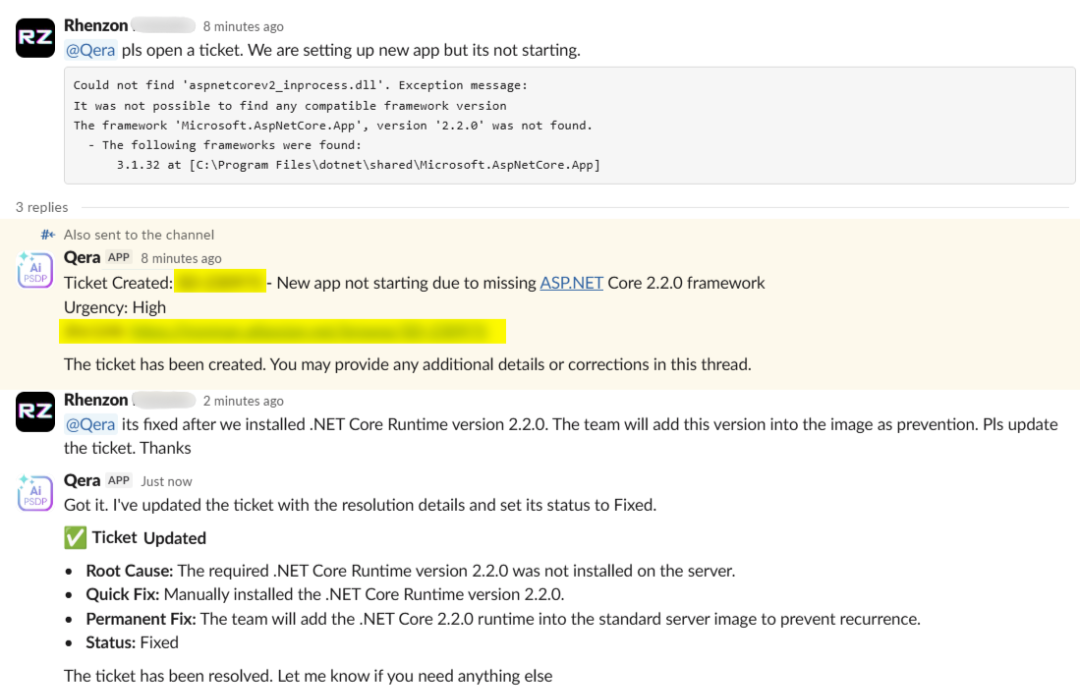
For Rhenzon, who’s been with Titansoft for 10 years, that belief became the driving force behind one of his department’s biggest projects: Qera, an AI assistant that now handles nearly 60% of support tickets.
But this story isn’t just about building a tool. It’s about how curiosity, empathy, and teamwork came together to make work more meaningful for everyone. It all stems from a culture where the people are the main reason Rhenzon has stayed so long.
From Excitement to Action
When Titansoft first encouraged teams to explore the use of AI, the whole company buzzed with excitement. People shared new tools, learnt about image generators, and experimented with AI prompts.
But after a few months, the discussions slowed down. The initial spark of curiosity had started to fade.
That was when Rhenzon, driven by one of Titansoft’s Core Value of Emergent Leadership, decided to act.
“I noticed that people were running out of things to share. So I thought, instead of just talking about AI, why not create something useful for our team?”
He proposed an idea: form a small internal team to explore how AI could actually help with processes in the support department, which manages support tickets. This idea came from his belief that if you have something valuable to share, you have a “moral responsibility to share it.” With the support of his manager, he gathered a few passionate teammates, including Mow, Kurt, and Adam and started brainstorming.
The Birth of Qera and the Power of Relationships
The team focused on a real pain point that Rhenzon, with his deep background in support, knew well: how much time Customer Analysts spent summarising customer issues before assigning the right person to the tickets.
“Before Qera, we would spend a lot of time figuring out how to describe an issue in a clear, non-technical way,” Rhenzon explains. “This takes away actual time to fix the ticket.”
They visualised an AI assistant that could help summarise tickets quickly and accurately, freeing up time for higher-value work. Using existing tools and some light scripting, the team built their first version of Qera—an AI that could read customer reports, identify the main problem, and suggest clear summaries.
For Rhenzon, this collaboration was only possible because of his decade spent building strong relationships. As a Customer Analyst, he realised early on that he couldn’t fix everything himself. Instead, his job was to “find the right people” who could solve the problem. That realisation, and the trust he built with colleagues, was the basis of Qera.
Today, Qera processes more than half of all incoming tickets, making it one of the department’s most effective innovations.
AI with Empathy: Why Humans Still Matter
For Rhenzon, creating Qera was never about replacing people. It was about enhancing what they could do.
“AI can understand what is being reported, but it cannot understand emotion,” he says. “When customers report an issue, there is always emotion behind it. That part still needs a human touch.”
That belief shaped how Qera was designed. The team decided to keep it as an internal tool rather than letting customers interact with it directly. By keeping humans in the loop, the team ensured that empathy remained at the centre of every customer interaction.
“AI should help us work better,” Rhenzon says, “not take away the connection we have with the people we support.”
The Human Side of Innovation and Growth
Qera was also a bridge that connected people, not just within the department, but across three different Titansoft offices. Each team had its own product lines and working styles, but the shared interest in automation brought them together. Rhenzon, working alongside teammates Mow, Kurt, and Adam, drove this effort.
“It was the first project where all three offices worked so closely,” Rhenzon says. “Because everyone was passionate about the idea, collaboration came naturally.”
This passion transformed Rhenzon into an “accidental team leader,” forcing him to hone his people management skills. The most rewarding part of Qera’s journey was seeing his teammates grow.
“One of my teammates was amazing at scripting, but he never had the chance to show it,” he says. “This project gave him that opportunity.”
By giving others space to explore their strengths, Rhenzon discovered the deeper value of innovation; it’s not only about what you build, but growing along the way.

When AI Meets Heart
Qera started as an experiment, but it became something much more. It showed that AI and empathy work best when they are together, making each other stronger.
It also reiterated Rhenzon’s core philosophy: to excel, you must focus on a “good working relationship with people, celebrating wins and enduring hardships together.” This strong human connection is why he has stayed so long.
“Seeing how the team uses Qera now makes me happy,” Rhenzon says. “It saves time, but more importantly, it lets people focus on what really matters.”
In a world where technology often tries to replace the human touch, Qera proves that innovation, backed by a value-driven approach and strong human connections, can actually make work more human instead.
A Culture That Makes It Possible
Projects like Qera don’t happen by chance, they happen because of the company culture. Titansoft believes in giving people the freedom to explore beyond their roles.
Rhenzon’s action proves that employees are trusted to “Lead the change they want to see”. This is one of Titansoft’s core beliefs: with even the smallest ideas, Titaners get to have a say in making improvements, embarking on a new project, and continuously exploring new technology and processes.
“Here, if you have a clear idea of what you want to do, people will support you,” says Rhenzon.
That trust is what keeps innovation alive and what allows people like Rhenzon to turn a simple curiosity into something extraordinary.
 T.8ytes by Titansoft