From Survival to Belonging: A Human-Centered Approach to Leadership Integration
By Jasmine Huang
This article is contributed by Jasmine Huang from Titansoft’s Organization Development (OD) department. In it, she reflects on a recurring organizational phenomenon: when strong leaders struggle to integrate successfully, the issue often goes beyond the individual and instead reveals gaps in the organization’s own structure and readiness.
Jasmine explores the idea of treating leadership integration as an organizational capability, and shares how Titansoft has redesigned its support systems and dialogue practices in real-world settings, by placing people at the center of the approach.
We often believe that hiring a great leader is the hardest part. Months of interviews, reference checks, and careful deliberation lead to a final decision. Once they arrive, we hand them a laptop, a 90-day plan, and trust that their experience will carry them forward.
And then, quietly, something starts to break.
A few years ago, I noticed a troubling pattern in our organization: several experienced managers resigned within their first 90 days. These were not performance issues; each of them had strong track records and went on to succeed elsewhere. The problem wasn’t talent.
The question we had to face was more uncomfortable:
What was missing in our system that made it difficult for capable leaders to integrate?
When I spoke with those who had left to find the common threads in their stories, three clear themes emerged:
- The Emotional Weight: A significant struggle to navigate the unwritten rules of our culture.
- The Guessing Game: Managing the pressure of implicit, unspoken expectations from supervisors.
- The Isolation: A lack of clear guidance and support during the critical transition period.
Leadership integration isn’t about helping individuals “catch up” faster; it’s about the organization’s capacity to grow with new leaders. At Titansoft, we view integration struggles as organizational signals rather than individual failures. Because humans aren’t mechanical software updates, we must move beyond technical checklists to focus on the emotional complexity of true human integration.
The Myth of the “Plug-and-Play” Leader
Organizations often treat onboarding like a software update: install, configure, and expect everything to run smoothly. But leaders are not systems—they are people entering a dense network of history, relationships, and unspoken assumptions.
We tend to overvalue technical competence—what a leader knows—and underestimate the complexity of cultural integration—how a leader belongs. When we expect new managers to be fully self-sufficient from day one, we unintentionally create anxiety that undermines their effectiveness.
Every organization has what I think of as a “cultural immune system”. Like a body rejecting a foreign organ, a strong culture can unconsciously resist unfamiliar perspectives. Without intentional support, even the most capable leaders end up spending their energy trying to survive the culture instead of leading within it.
1. Making the Invisible Visible: Decoding Cultural DNA
One early case made this challenge especially clear. When a new HR Manager, Christina, joined us, she was clearly capable—yet constantly uncertain. She was navigating a map she couldn’t see.
To help her, I referenced the INSEAD Professor Anderson’ Culture Model, an expanded application of Edgar Schein’s three levels of organizational culture:
- Artifacts and Espoused Values: The visible layer—the office layout, the dress code, and the stated values.
- Underlying Assumptions: The invisible layer where real decisions are shaped. In Professor Anderson’s culture model, these assumptions are translated into practical language:
- Tribal Identity: What it takes to be an insider.
- Shared Meaning: The rituals and habits that signal alignment.
- Shared Assumptions: Beliefs so deep they are rarely questioned.
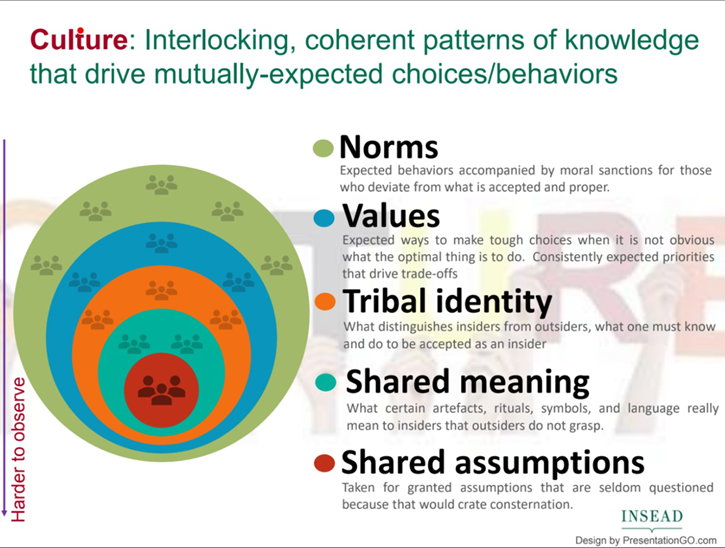
We realized that by only giving Christina a handbook, we were leaving her to guess at these deeper layers. Consequently, we shifted our approach. We shared our history—the stories of past failures and the “why” behind our rituals. We also paired her with a peer manager, creating a safe channel for questions people often hesitate to ask their direct supervisor.
The shift was subtle but powerful. Christina moved from trying to fit in—which requires a mask—to belonging, which allows authenticity. When leaders understand the room, they stop worrying about hidden landmines and start contributing with confidence.
2. Creating a “Container” for the Anxiety
Understanding the culture is only the first step; integration is not just cognitive—it is emotional. To support leaders under the anxiety and pressure of transition, we designed what psychologists call a “holding environment”: a space that manages the stress of a new role so they can think clearly. We replaced the routine status update with a bi-weekly sync-up focused on two principles:
- Making the Implicit, Explicit: Supervisors clearly define the leader’s primary tasks, expectations, and decision boundaries. When leaders know where they have autonomy, anxiety drops significantly.
- Treating Emotions as Data: We use an “Emotion Wheel” to check in—not to be therapeutic, but to be precise.
As Ludwig Wittgenstein observed, “The limits of my language mean the limits of my world.” Brené Brown echoes this in Atlas of the Heart: when we cannot name our experience, the emotion takes control. “Stressed” is vague. “Unsupported” or “overextended” points to action. Naming friction turns discomfort into insight.
3. Reflection as a Leadership Practice
While most onboarding processes demand immediate output, effective leadership requires reflection. To bridge this gap, we ask leaders to step out of execution mode once a month and journal around six prompts:
- Emotional patterns they noticed
- Moments of inspiration and frustration
- Personal triggers and reactions
- Gaps in support
- Self-care practices
- Emerging insights
This practice transforms raw experience into learning. By stepping back, they become more aware of cultural dynamics and better equipped to make thoughtful decisions.
4. Providing a Secure Base
New leaders often feel they must project constant confidence upward which leaves no space to process the very real anxiety of a transition. My role in this process is to serve as a “secure base”—a coach outside the performance evaluation chain where they can be honest about the journey.
Since we are often still unfamiliar with one another at the start, I build trust quickly using Charles Feltman’s four pillars: Care, Sincerity, Reliability, and Competence. I lead with transparency, sharing my intentions and background to establish a “Psychological Contract” focused on their personal well-being. I set one boundary clearly from the beginning:
“I am here to help you navigate the system, not to grade your performance.”
By normalizing the fact that transition is a struggle, we create a space where leaders can unpack raw emotions without judgment. When leaders realize they don’t need to “perform” for their coach, tension eases. They regain the emotional clarity needed to return to their teams and lead effectively.
5. Closing the Loop with a Retrospective
At the 90-day mark, we hold a retrospective focused on the integration journey. Leaders can choose to conclude the process or extend support for another three months. If extended, coaching remains monthly, while supervisor sync-ups adjust based on actual needs. The process remains adaptive—supportive, not prescriptive.
From Onboarding to Integration
This framework did not stop with exexternal hires. As we saw its impact, we expanded it to support internally promoted leaders as well. Even when the culture is familiar, stepping into leadership—often over former peers—is still a major transition.
Whether leaders join from outside or rise from within, the goal remains the same: support the person, not just the role. Onboarding is a bridge between a leader’s expertise and the team’s collective success. When leaders are given the language to name friction—and a secure base to process it—they do not just stay. They belong. And when leaders belong, they don’t just stay—they perform, and the organization moves forward with them.
Sources
Anderson, Philip (2014). Note on Organizational Culture. INSEAD.
Brown, Brené (2021). Atlas of the Heart: Mapping Meaningful Connection and the Language of Human Experience. Random House.
Feltman, Charles (2008). The Thin Book of Trust; An Essential Primer for Building Trust at Work. Thin Book Publishing.
Schein, Edgar H. (1990). Organizational Culture. American Psychologist.
Van Buskirk, W., & McGrath, D. (1999). Organizational Cultures as Holding Environments. Human Relations.
 T.8ytes by Titansoft