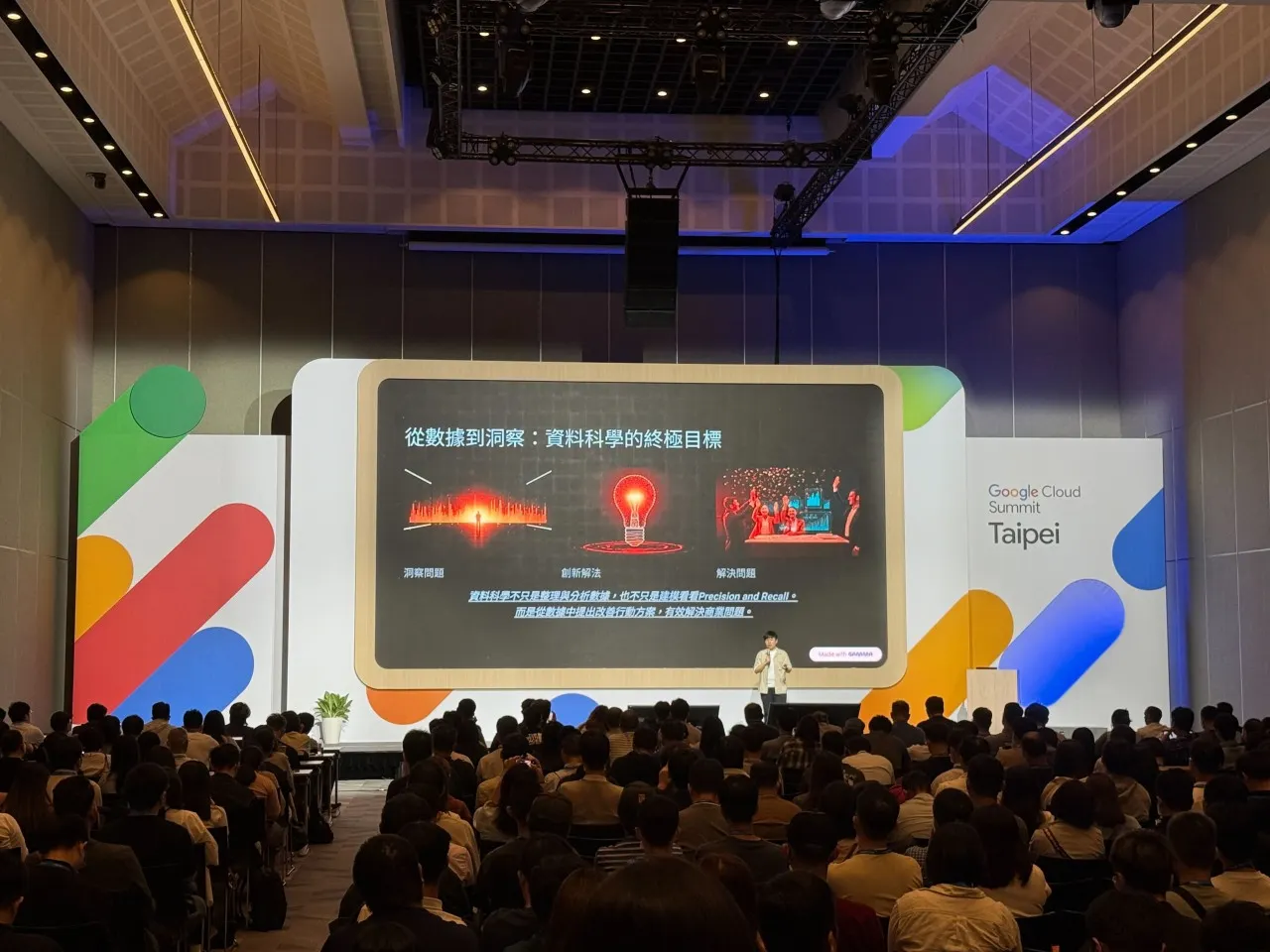
At the 2025 Google Cloud Summit in Taipei, Google Cloud spotlighted how AI is accelerating industrial transformation, inviting several companies to share real-world applications. Singapore-based Titansoft presented how it uses an Agile mindset of small experiments and continuous iteration along with generative AI to help businesses uncover insights from data noise and create AI solutions that truly deliver results. Their approach redefined the value and role of AI within organizations, from technical applications to workflow integration.
Google Cloud Taiwan Managing Director Kaixin Chen opened the summit by stating, “AI is reshaping the world at an unprecedented pace. For Taiwan, this is a pivotal moment for industries to level up and boost competitiveness.” He emphasized Google Cloud’s full-stack AI infrastructure and generative AI capabilities as critical tools to help Taiwanese businesses accelerate their digital transformation.
Among the speakers were hands-on industry leaders who showcased how cloud and AI technologies can move beyond buzzwords into practical, deployable solutions. Titansoft, a software company specializing in B2B online platform development, was one of the featured presenters. Known for its Agile development culture, the company was represented by Yupei, Product R&D Manager, who delivered a talk titled:
“The Future of Data with AI: Autonomy and Intelligent Agents”
She discussed how AI is reshaping decision-making within organizations, guiding teams from messy data to clear insights, while redefining AI’s true organizational value.
AI Is Not Omnipotent; The Core Lies In Problem Definition
Yupei began by pointing out: “AI is only effective when the problem is clearly defined. It’s human intelligence that tackles the fuzzy and uncertain.” This belief is central to how Titansoft implements AI: not to chase the latest trend, but to stay laser-focused on identifying the right problems to solve.
Titansoft’s Product R&D Department has a dedicated laboratory, Lab 57, bringing together engineers from Taiwan and Singapore, focusing on AI innovation and data insight. At its core is the scientific method, with six integrated steps:
- Observation
- Asking questions
- Research
- Hypothesis
- Experiment
- Analysis & Conclusion
This structure supports systematic, testable AI development. It enables the team to define direction and strategy even when data is unclear.
Yupei stressed: “We don’t follow the hype. We clarify the problem first, then choose the tools.”
In today’s ever-evolving AI landscape, many companies fall into the trap of picking tools before defining use cases. Yupei emphasized the importance of starting with a clear understanding of business needs and goals to make the right tech choices.
This workflow design also makes the Proof of Concept (POC) a regular strategy in Agile development. At Titansoft, large projects are broken into small, testable modules with specific success metrics and evaluation criteria. Each POC acts as a controlled-risk experiment that gathers real user and system feedback. This iterative model allows teams to fine-tune their models and processes without overcommitting to the wrong direction.
“We’re not afraid of failure,” said Yupei, “but we design the process so that the risk of failure can be controlled, and only then is there room for innovation to occur.”
This test-first development culture increases product success rates while maintaining flexibility and stability under fast-changing requirements.

Case Study: AI-Powered Customer Service Summary System Increases Efficiency by 50%
Titansoft specializes in B2B software development. Instead of being responsible for platform operation, the company starts with the client’s business needs, customizes system solutions, and helps them focus on core services, optimize processes, and further enhance operational efficiency and decision quality. One standout case involved co-developing an AI-based summarization and issue classification system that significantly boosted customer service productivity.
The system can instantly generate summaries and categorize issues from multilingual and multi-modal customer service conversations. The result?
- 85% classification accuracy
- 80% summary adoption rate
- 50% time saved on data consolidation
This freed up the customer service team to dedicate their time to more valuable tasks, such as in-depth analysis, collecting customer insights, and optimizing service workflows.
“AI gives us consistent standards, no more varying interpretations from different agents,” Yupei said. “It also frees up time, so we can reinvest in improving service quality.”
She added that customer service teams are often the first to spot real product or service issues. With more time and clarity, they can provide valuable feedback to R&D and decision-makers. It not only enhances the overall customer experience but also strengthens cross-departmental collaboration and optimization cycles.
This is not just technical optimization; it is a restructuring of decision logic and work processes. Yupei emphasized that AI implementation shouldn’t be about tech for tech’s sake. It should solve real business goals, and that means considering both cost and effectiveness.
“Just because you can build something, doesn’t mean it’s worth building. That’s the real question decision-makers must ask.”
Finding the right balance between expected outcomes and actual costs is what makes AI a long-term asset to the organization.
From Learner to Leader: A Career Roadmap for the AI Era
To all professionals navigating the AI wave, Yupei advised:
“You don’t need to know everything. What matters is why you learn something, and what for.”
In an age where tools evolve constantly, the real differentiator isn’t speed, it’s the ability to define problems and find the right entry point.
She wrapped up her talk with a forward-looking framework for career development in the AI era:
1. Early-Career Professionals
Focus not just on technical skills, but on developing business context awareness and domain knowledge. Don’t try to become a jack-of-all-trades. Instead, start by asking:
- “Why are we doing this?”
- “What’s the real need behind this request?”
Understanding the value chain and how your industry works sets a strong foundation for growth.
2. Experienced Professionals
Shift from solving problems to defining them. Mentorship is key.
“As a senior, your role isn’t just to solve problems, but also to guide juniors through questioning and reasoning.”
Teach frameworks, not just fixes. “Sometimes, juniors get stuck on technical details. Our job is to teach them how to fish, not just give them the fish.”
3. Managers
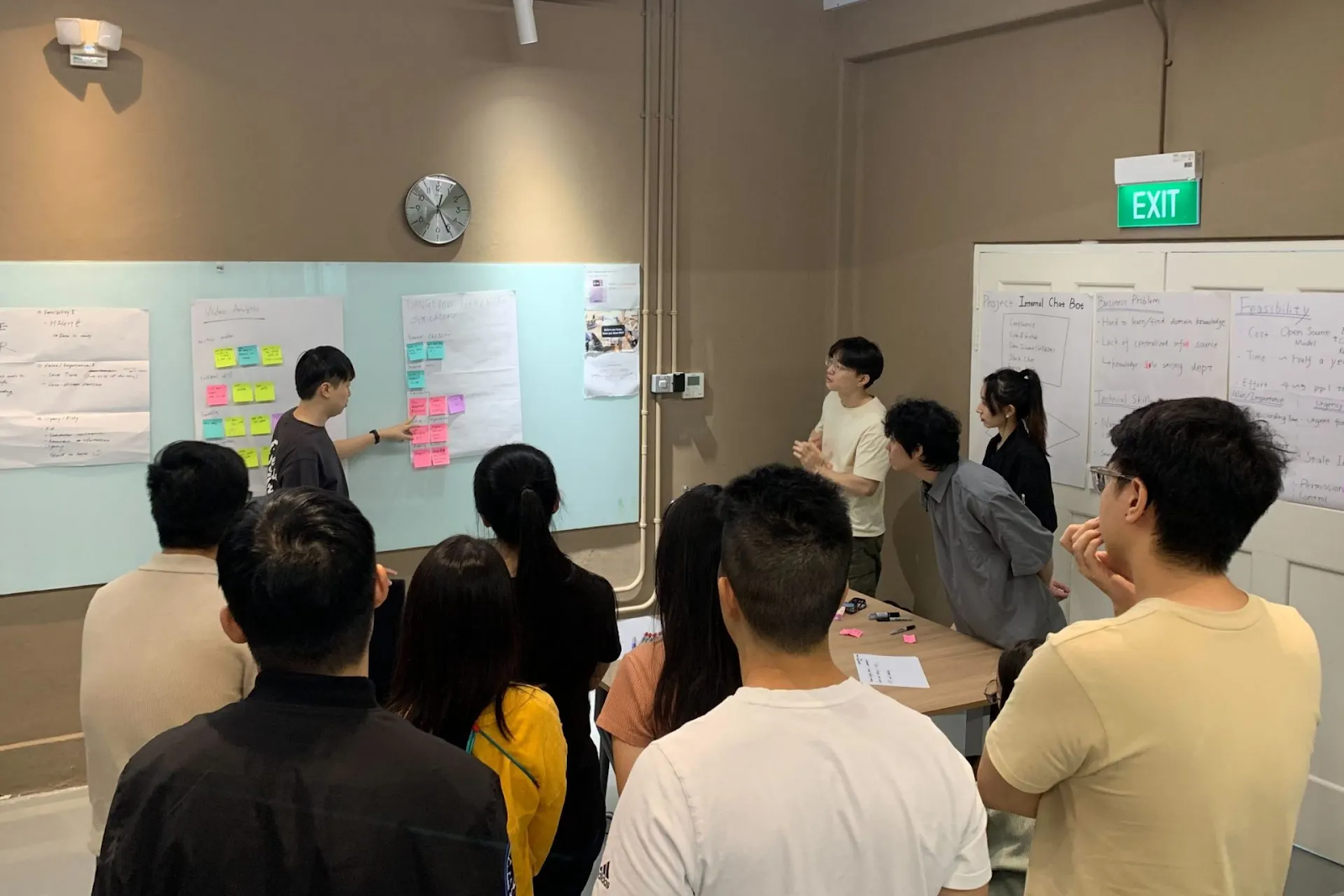
Think about team design and how to build AI-collaborative, adaptable workflows. Diversity matters and team configuration should not just look for “the same people”. Innovation thrives through varied perspectives. Design processes that allow for error tolerance and rapid iteration so innovation becomes normal, not exceptional.
“We don’t adopt AI for its own sake, we use it to solve real business problems.”
This quote encapsulates Yupei’s message and Titansoft’s practical approach to cloud and AI integration.
After the session, many tech leaders gave positive feedback, saying Yupei’s talk gave them confidence and clarity on how to lead their teams through AI-driven change.
Yupei said she was very happy that her sharing resonated with the technical managers present, because “We are trying to solve problems every day, but sometimes we also doubt whether our direction is correct. If my experience can help others take fewer detours, it is worth it.”
Her talk resonated deeply with attendees, showing that what the tech world needs most today is not a universal skills checklist, but a return to the core purpose of our work: helping each other get things done, and get them done right.
This exchange and feedback also highlighted the high demand among today’s technology leaders for practical experience and knowledge sharing in a rapidly changing environment. Through specific case studies and process decomposition, the audience not only gained inspiration but could also bring back practical applications to their organizations, further shaping a work culture centered on learning and continuous evolution.
 T.8ytes by Titansoft