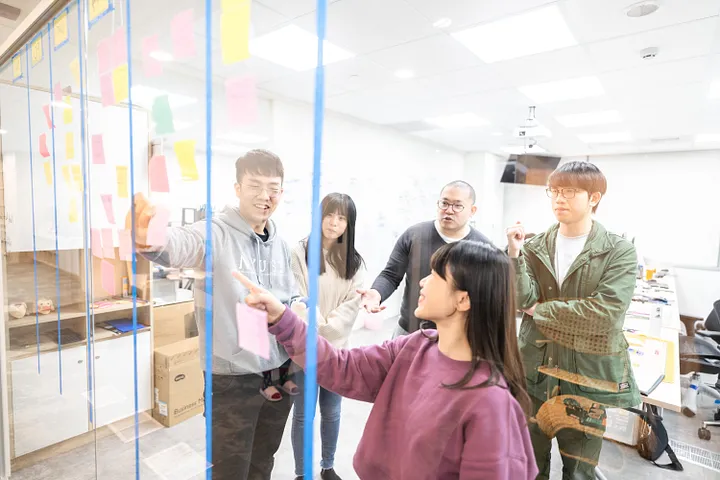
ScrumMaster (commonly abbreviated as SM) is one of the essential roles for a team to execute Scrum, responsible for ensuring that the team operates within the Scrum framework and fostering communication and efficiency within the team. According to the Scrum Guide, the SM’s responsibility is to establish Scrum based on the Scrum Guide and ensure the team adheres to Scrum principles, practices, and rules.
At Titansoft, seven full-time SMs are embedded in the development teams, observing meetings, offering suggestions, and providing feedback. They help team members implement agile practices and achieve business value goals. They actively share and adjust various agile and Scrum-related activities for the organization. For example, all Titansoft employees, regardless of their position or role, have undergone agile knowledge training conducted by the SMs.
When Titansoft initially adopted Scrum, the company received agile training from Odd-e, a program founded by Bas, one of the authors of the Scrum Primer. As a result, Titansoft’s agile framework is rooted in the Scrum Primer and supplemented by the Scrum Guide. Team members have also expanded their knowledge through certifications like CSM, CSPO, CSP-SM, RSM, RPO, LeSS, Scrum@Scale, and PMP, which brings them various perspectives.
The SM acts as a catalyst in an agile organization, helping teams realize their potential and deliver business value through teaching, facilitation, and coaching. However, as the saying goes, “the hardest problems to solve are always people problems.” What qualities should someone in such a highly interpersonal role possess? As one of the few companies in Taiwan with full-time SMs, how does Titansoft flexibly apply SM’s skills in daily work meetings and product development? This article takes you behind the scenes of Titansoft’s cross-functional SM team!

What are the responsibilities of a ScrumMaster at Titansoft? Expanding influence across teams, departments, and the organization!
At Titansoft, ScrumMasters (SMs) are like the lifeblood of the organization, overseeing various development teams while also influencing departments, the organization as a whole, and even external communities. Their impact starts small but extends outward into different dimensions. Let’s explore their work from three perspectives: team, department, and organization.
🙋♂️ The mindset of a ScrumMaster:
Simply put, “the ScrumMaster’s product is the team.” From a Scrum perspective, no matter which meeting they attend, they act as transparent evaluators and adjusters, helping teams achieve business value.
👉 Facilitators of dialogue: As a facilitator, they encourage open communication and foster collaboration among team members.
👉Adaptation supporter: They assist the organization in adapting and adjusting to the current environment.
👉Alignment advocate: They initiate conversations that align the culture and values of both the organization and the team.
🙋♂️ Focusing on the Development Team’s Work:
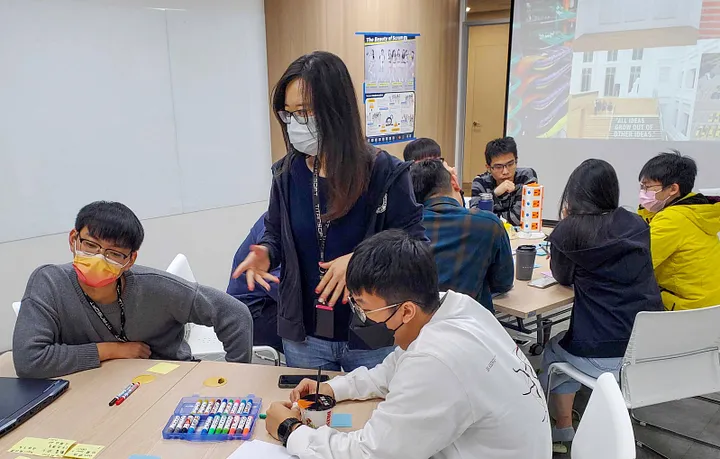
- Facilitating Collaboration Among Development Team Members: SMs participate in Sprint Planning, Sprint Review, and Sprint Retrospective meetings, observing and offering suggestions and feedback. They may also modify the format of meetings to improve development efficiency, which requires spending significant time with team members to record, discuss, or address issues.
- Leading Retrospective Meetings: The Sprint Retrospective is crucial in Scrum. SMs design the meeting segments, facilitate discussions, and help team members identify ways to improve their interactions while maintaining the framework’s flexibility. The frequency of retrospectives varies by team, such as weekly, at the end of each sprint, monthly, or irregularly.
- Enhancing Team Members’ Understanding of Scrum: By observing the team, providing feedback, and having one-on-one conversations, SMs help team members understand Scrum and agile methodologies better and address any related doubts.
SM is like a ‘coach’ in a team. Imagine a sports team—does a ‘coach’ necessarily have better control over the game than the star pitcher? Is a coach always more accurate than the leading shooter? The answer is not necessarily. A coach is more like a strategic thinker, ensuring everything is executed step by step, placing each person in the role that best suits their strengths, and maximizing the value of the entire team. SM is this coach. They are not the team’s secretary or the person updating the scoreboard. At the right moment, SM reminds you not to forget the framework, not to become too fixated on Scrum, and to remember where the value lies. When team members stray off course, SM helps steer everyone back on track.
🙋♂️ Focusing on Departmental Work:
- Participating in Departmental Meeting Processes: With multiple development teams under each department, there are many department-level meetings, such as Cross-team Retrospectives, Overall Retrospectives, Deep Retrospectives, Double-link meetings, and Outlink Selections. SMs play a crucial role in these meetings, helping to focus on issues, guiding discussions, and collecting feedback to improve meetings or processes.
- Facilitating Collaboration Between Teams Within the Department: Besides improving agility through departmental meetings, SMs also suggest new tools or methods to teams or department leaders. For example, during the pandemic in 2020, Titansoft transitioned to remote work and the SMs sought various online tools for team members, including recommending improvements to Jira Software and promoting Miro for diverse uses.
- Improving People-Related Aspects: Helping team members adapt and grow, recognizing requirements and progress. For example, Titansoft invited a counseling psychologist to implement a psychological safety project, and the SM collaborated with the psychologist to drive and design the content.
🙋♂️ Focusing on Organizational Work:
- Improving Organizational Structure and Aligning with Organizational Vision: SMs are agile experts within the organization, tasked with ensuring that various scenarios align with organizational values and continuously iterating to improve the organizational structure. They gather feedback by interviewing different functions about various events and brainstorm ways to improve processes.
- External Communication of Titansoft’s Experience: Engaging with both local and international agile communities, sharing agile thinking, and discussing Titansoft’s practical experiences.

Why are Full-Time ScrumMasters Important? Titansoft’s Cross-Functional SMs Generate Synergies
Agile is all about people, which is why having a full-time ScrumMaster (SM) is crucial for providing a holistic perspective and assistance. Imagine if engineers or product owners took on SM responsibilities part-time; their values, perspectives, and goals may not fully align with those of a dedicated SM, leading to confusion. Moreover, if the SM is not embedded within the team, how can they truly understand the current mental and physical state of each team member? This is one of the reasons Titansoft employs full-time SMs!

At Titansoft, ScrumMasters (SMs) come from diverse professional backgrounds, including education, software engineering, project management, product management, and MIS. Titansoft believes that cross-functional teams are crucial partners in the agile process, and the combined skills of each SM contribute to the overall effectiveness of the team.
Unlike typical engineering roles that are categorized into Senior and Junior based on experience, Titansoft does not distinguish SMs in this manner. Instead, each SM is assessed based on job grades, with specific conditions and influence outlined for each level. Each SM has unique expertise: some are proficient in programming languages and contribute to technical growth, while others excel in facilitating team communication and creating business-oriented product thinking. These different areas of expertise bring varying impacts to the company and team, making it difficult to define by seniority alone.
SMs serve both the department and the team while also being part of the organizational structure. As the company grows and the number of people increases, SMs cannot work in isolation but must leverage their individual strengths to create a collaborative learning circle, where they act as coaches and mentors for each other. Titansoft believes that “to go fast, go alone. To go far, go together,” and supports SMs in continuously learning, experimenting with new ideas, and iterating improvements. This embodies the belief of “Never Stop Improving.”
Thank you to Titansoft ScrumMasters Herdy Su, Oakley Hsu, Sally Wang, Maureen Chen, Sam Huang, Sherry Tseng, and Jeanice Wong for providing information for this article.
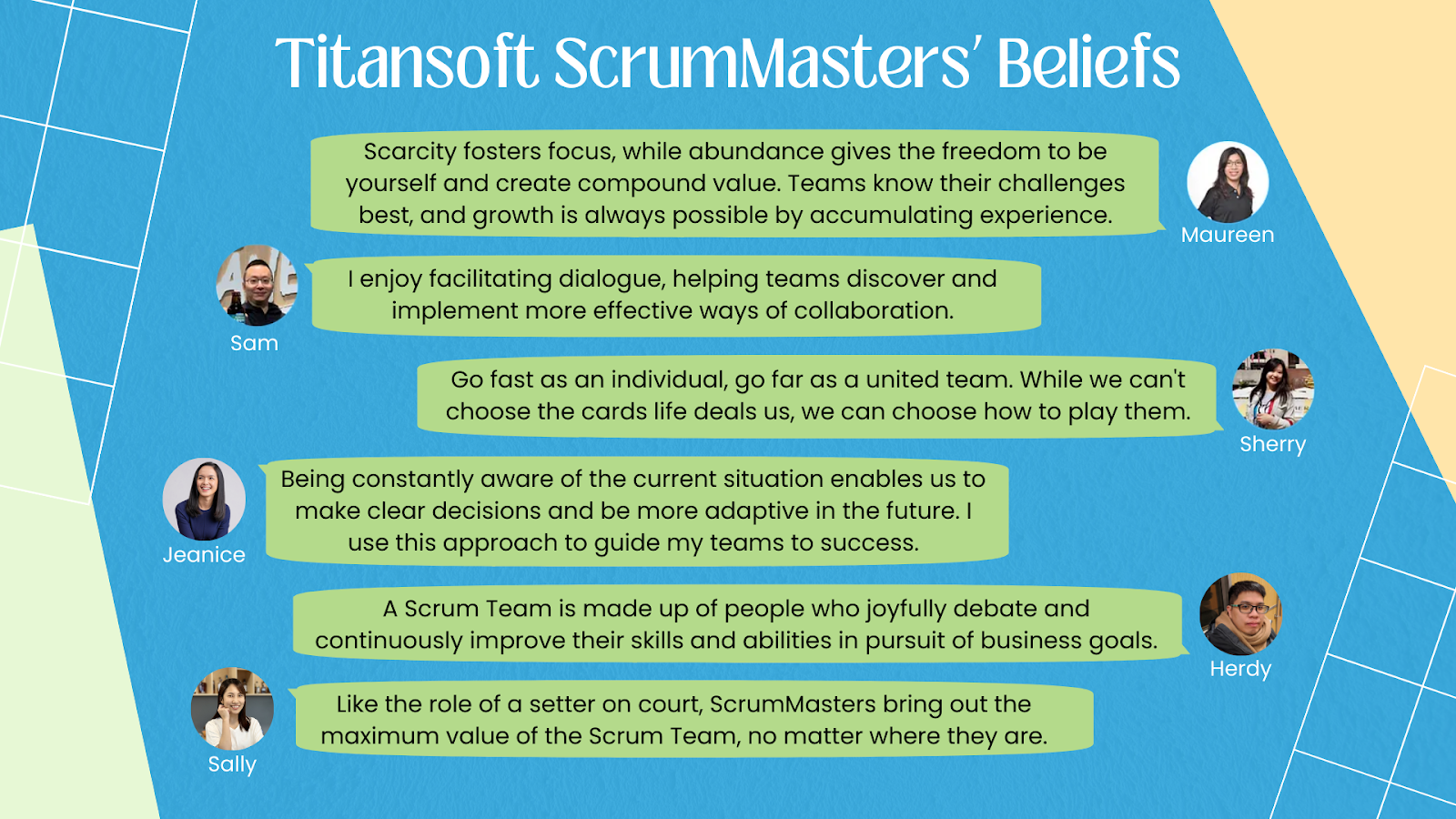
Recommended by Titansoft: The Great ScrumMaster book guides ScrumMasters, effectively helping them develop the mindset and skills needed to handle various situations they may encounter in their role.
 T.8ytes by Titansoft