The traditional definition of leadership emphasizes formal positions, authority, and power, leading most people to blindly follow and execute orders. Esther Derby emphasizes that leadership should not depend on hierarchy; leaders can be found at every level. We should strive to create an environment where everyone can exercise personal leadership within the organization.

Esther Derby, who has 40 years of experience in leading, observing, and practicing organizational change, was invited by Titansoft to deliver the opening keynote speech at the 2023 Agile Summit. In recent years, Titansoft has been actively introducing international speakers to Taiwan for in-person exchanges, hoping to add depth and diversity to Agile community events and provide opportunities for face-to-face consultations with masters in the field.
As a senior figure in the Agile community, Esther has worked with various organizations ranging from startups to Fortune 500 companies. As a consultant, speaker, and author, she is known for helping teams improve productivity and has written over 100 articles on management, leadership, collaboration, organization, and change.
Her famous talk, “Leaders at All Levels,” is also the keynote topic for the 2023 Agile Summit. In this talk, she leads the audience in exploring a different definition of “leadership,” advocating that anyone at any level of an organization can be a leader. She begins her speech with a profound question:
Do you see yourself as a leader?
Most people’s traditional definition of a leader comes from Western notions, emphasizing formal titles, positions, authority, and power. However, she reminds us that while these definitions might have been sufficient in another era, in an environment that requires rapid response to change and continuous organizational improvement, we need different types of leadership and leaders.
This prompts us to think in new ways:
What is leadership, and what should a leader do?
Leadership doesn’t require a title; everyone is a leader.
She emphasizes that leadership does not necessarily require a formal title and challenges the limitations brought by traditional definitions of leadership—these normative views from the West overemphasize an individual’s charisma and persuasiveness, imposing constraints on organizations and affecting people’s autonomy, making them feel they must blindly follow and execute orders. This is not beneficial for the long-term development of an organization, as following orders lowers people’s engagement and eventually leads to passive waiting for instructions.
Software management guru Gerald Weinberg once said:
Leadership is the ability to enhance the environment so that everyone becomes empowered to contribute creatively.
Making the Diamonds in the Company Bigger
When a company has more than 20 employees, opinions begin to diverge. Core employees clearly understand the company’s context and values, but newcomers are increasingly distant from this knowledge. When problems are small, they often go unheard or unnoticed until they escalate into significant issues, posing risks to the organization.
Esther cited an example where the owner of a company with over 700 employees told her that it was challenging to find people willing to take initiative. The issue was that employees had become accustomed to waiting for orders from above to avoid making mistakes, indicating a culture that limits participation and leadership.
Does this sound familiar? Let’s work together to make the diamonds bigger!
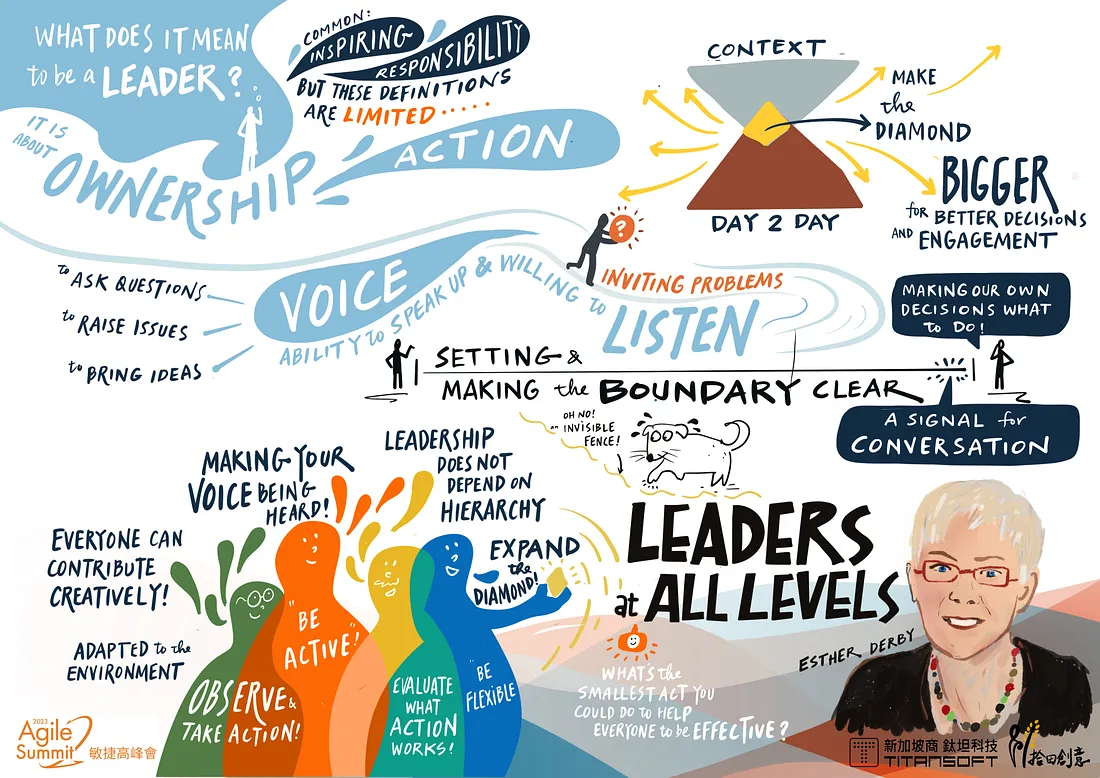
The so-called “diamonds” refer to the company’s “contextual knowledge” and “front-line knowledge,” with the overlapping area representing the knowledge created by their intersection.
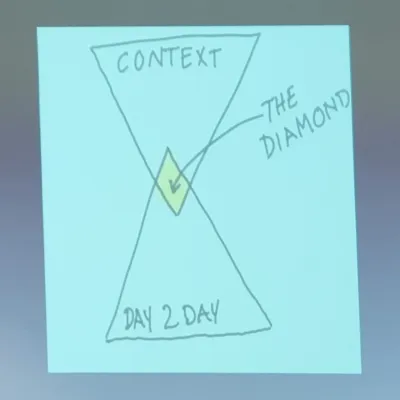
For example, when upper management may not understand how to develop software but expects lower-level employees to complete software development quickly, it can lead to unreasonable deadlines and foolish decisions. On the other hand, lower-level employees lack contextual knowledge and cannot accurately identify problems, but their intuition tells them something is wrong.
When the range of the diamond intersection is not large enough, there is a lack of trust among people, and they always wait to be told what to do. Enlarging the intersection in the middle increases everyone’s participation and involvement in making decisions.
Creating a Team with Diverse Voices
She pointed out that this is not an easy task because the power of speech can bring risks, and the hierarchical system tends to increase conflicts within the organization. However, creating such an environment is necessary because if people in the organization are afraid or unwilling to voice their ideas, they may wait until the problem becomes severe before speaking up.
Creating an environment where everyone can easily share ideas and suggestions, and giving everyone the opportunity to monitor and observe internal problems starts with establishing a culture where everyone is willing to listen to others’ opinions. Additionally, leaders with formal titles can proactively ask team members and clearly express the importance of early problem detection.
“Maybe I will be disappointed or unhappy, but it is not with you personally, but with the whole situation. I would like to know about the issue as early as possible.”
New employees usually see problems easily, so they should be encouraged to share their observations and ideas, which can bring new solutions and potentially highlight previously overlooked issues.
Esther mentioned the importance of middle management. She believes that middle managers should not just passively wait for others’ suggestions but should play a strategic role in decision-making. They should have the right to access information first and establish clear boundaries within the organization to enable team autonomy.
Next, she emphasized the importance of boundaries. First, set and clarify the boundaries so that the team knows what they can decide on their own, ultimately speeding up the decision-making process.
Set and Clarify Boundaries
Esther shared the story of an electronic invisible fence as an example. Her neighbor had a dog and set up an electronic invisible fence in the yard. The dog wore a collar that would instantly be shocked if it approached the fence, preventing it from leaving the yard.
Typically, electronic invisible fences are buried underground, but the neighbor, who was considering a move soon, placed the fence directly on the ground. As a result, the wires were blown around by the wind, and the fence’s range changed daily. Eventually, the dog didn’t even want to leave the porch.

This situation is akin to a team with ever-changing directives, where employees end up guessing the boundaries of decisions every day and eventually become hesitant to take initiative.
Esther suggests that it is best to clarify things from the start so that everyone knows what to do. Setting boundaries doesn’t mean they can’t be crossed; rather, when approaching the boundaries, employees should feel they can proactively discuss the matter with their supervisors before making a decision. Open and honest discussions should be encouraged so that everyone knows it’s okay to bring things up and that the rules set by someone aren’t unchangeable.
Helping everyone grow, helping the diamonds get bigger, and allowing smart employees to make decisions will speed things up.
Finally, Esther quoted Systems Thinking master Donella Meadows:
“The original purpose of a hierarchy is always to help its originating subsystems do their jobs better.”
She emphasized once again that the existence of a hierarchical system is not for leadership, and leadership should not rely on the hierarchy. As long as people are willing to exercise their leadership abilities, individuals at all levels can be leaders. What’s important is to stand up, share one’s views and ideas with others, and create an environment where everyone can lead.
 T.8ytes by Titansoft