In 2022, there was a trend of salary transparency in Europe and America, aimed at making the workplace fairer and achieving pay equality for men and women. However, is salary transparency really a panacea? Can it solve wage discrimination just by its implementation? Tomas Li, General Manager of Titansoft, said that salary transparency alone cannot solve the problem of unequal pay for equal work!

In the post-pandemic era, talent issues have become increasingly prominent. On one hand, there’s a strong demand for talent in the semiconductor industry, which has led to the displacement of traditional manufacturing and service sectors. On the other hand, the trend of remote work has prompted even multinational corporations (without branches in Singapore) to compete for talent in the Singaporean market.
Companies that find themselves at a disadvantage in these talent wars are invariably constrained by their industry environment, making it difficult for them to offer more attractive salary packages. Consequently, employees who are no longer willing to endure low pay and long hours are leaving in droves.
Of course, employees cannot be blamed for this. Ultimately, the relationship between employees and companies, and between labor and capital, is one of equality. Especially in today’s era where diversity, equity, and inclusion (DEI) have become prominent values, this equality is even more crucial.
The U.S. business magazine “Inc.” dubbed 2022 as the “Year of Pay Transparency” because states like New York, California, and Washington signed “Wage Transparency Laws” requiring companies big and small, including Apple, Disney, and Google, to disclose salary ranges in job advertisements starting from 2023.
Tomas Li, the General Manager of Titansoft, deeply relates to the benefits of salary transparency.
Titansoft is a Singaporean company that specialises in development and maintenance of online software. When recruiting in Singapore, its salary packages are often overshadowed by major corporations like Google and Facebook.
In order to attract talent, Titansoft has tried various methods, such as Agile, mindfulness, and the ultimate level of salary fairness, “salary transparency.”
In 2015, the former general manager Yves Lin suggested to Tomas, “Let’s try salary transparency!” After two years of adaptation, the turnover rate dropped from double digits to 5% in 2017. Titansoft was also selected by the Singapore Computer Society as one of the ten Best Tech Companies to work for in Singapore, alongside multinational companies like IBM!
Design principles for salary transparency:
- Key premise: Clear definition for every job task.
- Within the same job grade, provide further subdivision according to different salary grades.
Titansoft’s employee salaries are divided into three parts: monthly salary, performance bonuses, and benefits.
The monthly salary is estimated based on the “scope of professional contribution” and “market value”. Because salary comes from the company’s profit, the amount of profit depends on the strength of its own products. Therefore, the type of expertise required to create a product and the market value of that expertise determine the salaries of employees possessing that expertise.
For example, Google’s products may require software engineers with a PR value of 95 to develop; whereas for Titansoft’s products, talents with a PR of 80 are sufficient. In other words, the average salary of the top 20% of talent in the market becomes the basis for calculating monthly salary.
Titansoft obtains market salary distribution through talent consulting firm Willis Towers Watson. “Just throw out a number, if applicants don’t come, you know you’ve offered too little.” By comparing both, an estimate can be made of how much salary should be paid to employees meeting the criteria.
To avoid underestimating or overestimating employee abilities and thus providing incorrect salaries, the company must provide clear job descriptions (JD). For example, technical professionals (E, Expert) or managers (M, Manager); technical professionals are further divided into engineers (E3) and senior engineers (E4), with each level (such as engineer, senior engineer) subdivided into 3 grades (salary grades).
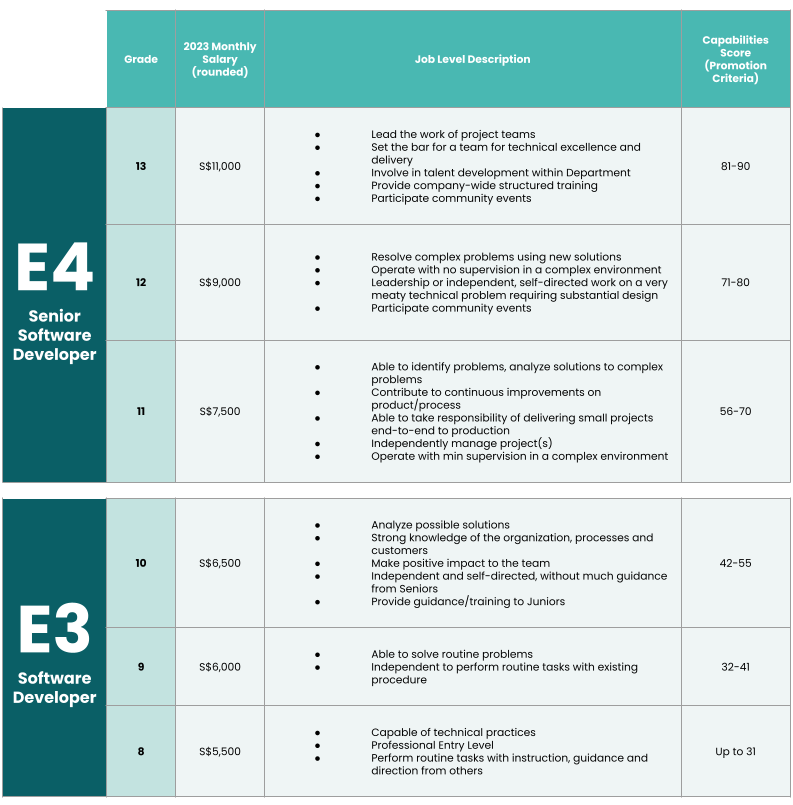
“Before candidates come in, they already know about the compensation; Titansoft’s salary is an open secret in this industry.”
Cindy Lin, PR manager of Titansoft, emphasizes that the purpose of the designations and grades is to provide a basis for employee promotion and salary calculation, rather than to emphasize hierarchy. Colleagues in the company define their own job titles. Tomas likes to promote interaction through drinks, so he’s labelled as a Bartender.
Seeking differentiation within similarity, allowing experts to skip levels and earn higher salaries:
1. Clear weighting of expected performance capabilities.
2. Quantified capabilities, self-promotion system.
It’s worth mentioning that for the same position, colleagues may not necessarily perform the same tasks; under the premise of the same salary, it’s easy to compare and speculate, ultimately leading to dissatisfaction. Therefore, for each job grade, Titansoft will list detailed standards (Guidelines) one by one.

From the chart, it can be seen that the most emphasized experience in general industries is “years of work,” but it only accounts for a small portion of the Titansoft salary calculation (with a weightage of x2). However, programming skills are very important, with a weightage of x6. Each promotion in job level (which also means an increase in salary) is composed of multiple conditions.
Taking E3 Developer John as an example, if he scores 58 points based on capability guidelines and weighted calculations, he meets the promotion criteria defined in E4 Senior Engineer. Hence, John can successfully be promoted to E4 (job grade 11).

In this way, employees of the same job grade will have different scores depending on the nature of their work. Even though they hold the same position, employees can see how many points they are away from promotion. If they are faster than others, they are less likely to complain.
However, for this method to succeed, there is a major premise: supervisors should not hinder employees’ promotions. Otherwise, even if the capability standards are met, if promotions are consistently blocked, the transparency of the company cannot motivate employees to strive.
In Titansoft, promotion is not determined by managers but by employees applying for promotion themselves.
Titaners who believe they have reached the standard for the next job grade, and obtain a recommendation letter from a peer, can apply for the evaluation panel.
The evaluation panel consists of five members: Department Manager, Product Manager, assigned team members, HR, and a peer chosen by the employee (advocate). After a two-hour Q&A session, the final decision on promotion is made.
“Be willing to learn and perform. You will be promoted on average within 12 months, maximum of 18 months. Are you up for it?” Tomas pointed to the form. The salary and position are transparent. “If you want to quickly reach a certain position, learn from your seniors at the corresponding level.” Tess Fang, manager of the Organizational Development department at Titansoft, said, “Every year, 1 to 2 employees are promoted ahead of schedule.”
Method of bonus distribution, defined:
1. Only consider merits, not hard work.
2. Self-organized peer evaluation to avoid free-riders.
The second component of salary is performance bonus. Employees possess expertise, but their expertise doesn’t always yield results. There are many influencing factors, such as the economy and company policies. These are beyond employees’ control, hence the saying, “Expertise is one part of the salary (monthly pay), while performance bonuses are independent.”
“Hard work guarantees only your monthly salary; bonuses are by merit.” However, no one believes they contribute less to the company. How can bonuses be distributed fairly without causing disagreements amongst colleagues and teams?
Tomas’ answer is “self-organization.“
Generally, profits are settled for each product annually. The Product Owners take 15% first, distributed to colleagues across departments, as they often contribute outside of their team and their contributions might be underestimated by team members.
The remaining 85% is distributed to each team according to the number of team members. For example, if Team A has 4 people, Team B has 7 people, and Team C has 6 people, the distribution ratio would be 20% for Team A, 35% for Team B, and 30% for Team C.
“The success of a product is not solely the achievement of a single team, which is why we use equal distribution; it’s more equitable.”
Bonuses go to the team, then members discuss and dispute how much each should take. “It’s transparent; any dissatisfaction or unnoticed contributions will be addressed here.”
For example, some colleagues might say, “I work overtime every day, so I should get 30%.” Another colleague might respond, “You only come to the office at 3 o’clock; your overtime is just an illusion.” Your contribution is verbalised, and you take what you deserve.
Of course, the implementation of self-organizating teams wasn’t smooth from the beginning; issues like “egalitarianism” occurred.
There was a senior engineer from Laos whose team members proposed “equal profit sharing.” As the senior, he should take care of his team; but based on his contributions, his bonus should be five times what it is now. He was very unwilling.
Later, Tomas asked him to consult the sibling team, finally learning the solution of “silent voting.” First, put the names of team members on the wall and let them vote. If they think someone has contributed, they write the percentage that person should receive under their name. No talking during the voting to avoid influencing judgments. The final result is fair; everyone’s contribution is quantified.
Won’t those who receive less complain? No, “Agile is already the culture of Titansoft; there’s a focus-meeting every week to clarify product responsibilities, individual responsibilities, and goal discrepancies.” Held 50 times a year, employees won’t wait until the end of the year to realize they received less in bonuses. “If they don’t meet their goals, they’re embarrassed themselves, so how can they come to you for promotion or a raise?”
Salary transparency may not be suitable for every organization:
1. Difficulty one: New positions keep emerging.
2. Difficulty two: Employees may overlook company benefits.
“In the past, 80% of positions had transparent salaries, but now only 55% remain,” explained Tomas. In some situations, such as for senior executives, salaries are not disclosed.
For senior executives, a large proportion of their salary comes from bonuses, while their fixed monthly salary may be relatively low, “with differences of up to 10 times.”
Why transparency with low monthly salaries? Because senior-level salaries represent the company’s ceiling in terms of compensation. If it’s too low, employees won’t be motivated to work hard.
For example, the President of Taiwan earns a monthly salary of NTD500,000 (~SGD21,000), lower than many high-level managers. In this case, why would civil servants strive to excel? No matter how hard they work, their salary can’t surpass the president’s!
Furthermore, agile companies constantly have many new positions emerging each year, and the salaries for these positions are also not disclosed. “Even the job descriptions are unclear, making it impossible to define market value.”
“Salary transparency isn’t necessarily better,” Tomas listed employee “benefits” such as company trips and health checkups, which are actually part of the salary, but employees often don’t see them as such.
On the eve of the COVID-19 outbreak, Singapore faced a shortage of masks, and not every company had a temperature measuring machine like they do now. At that time, Tomas spent SGD20,000 to buy an infrared thermal imager, the kind used at airports! Was it worth it? On hindsight, it was certainly not cost-effective, but at that time it provided employees with a sense of security. However, no matter how grateful they were, colleagues still didn’t see it as part of their salary.
“With non-transparent salaries, employees can’t divide them finely.” Ultimately, the purpose of salary transparency is to motivate employees to learn and work harder. If you have other ways to achieve the same effect, there’s no need to sacrifice everything to establish a transparent salary system from scratch.
Source of article: Cheers | 2023 DEI Report
 T.8ytes by Titansoft